GPD Win 4 Indiegogo Begins Soon

GPD has been making handheld PCs long before coveted Steam Deck hit the market. Their latest device, the GPD Win 4, is going to be launching soon on Indiegogo. We’ve looked at a lot of their PCs over the years, you can see them in my handheld device playlist here.

The Win 4 looks to be a lot smaller than Steam Deck yet should deliver better performance thanks to its Ryzen 6800U processor. There will be a version with 32GB of RAM and a 2TB NVME SSD. It has a 6″ 1080p display that can run at 40 or 60 hz that can be slid out to reveal a physical keyboard. Battery life will likely come in at around what the Steam Deck delivers so be sure to budget for some power banks for longer trips.

GPD Photo
GPD Photo

Also of note is that it will feature 40 gbps USB 4 ports that are Thunderbolt compatible for external GPUs and other high speed devices. The Win 4 will be running Windows 11 so it should be a good companion for Game Pass Ultimate subscribers who want to download games and take them on the road.

No pricing has been set yet but I expect this will likely cost more than Steam Deck if the prior editions are any indication. The Intel powered GPD Win 3 sold for $899 upon its release with an i7-1165G7 processor.

You can find their Indiegogo campaign here.

Starlink to Start Throttling Users

Via Michael Baylor on Twitter, it looks like Starlink is going to begin throttling users who consume more than 1TB of data transfers in a month.

Those who go beyond the allocation will be “depriortized” for the remainder of the month and will likely experience degraded connection speeds.

Here’s the notice Baylor received today:

Starlink will not run the bandwidth meter between 11pm and 7 am at the moment, so night owls should be ok for now.

It’ll be interesting to see how they’ll manage the continued growth of the service. I have a feeling this is just the beginning.

See my Starlink videos here!

Why Creators Should NOT Apply to the Walmart Creator Program Right Now

As many of you know a good portion of my revenue comes in from affiliate links that I place on my videos. With “social shopping” becoming more of a thing we’re starting to see major retailers develop programs that are better integrating into social video platforms.

That’s why I was interested in Walmart’s new “Walmart Creator” program, especially after some of the success I have found on Amazon’s influencer program. That was until I tried signing up for Walmart’s effort.

As a creator you’re asked to link your social media accounts to the Walmart Creator website. No biggie. But my alarm bells went off when I got to the next screen where they ask for what is essentially full control of my YouTube channel. Have a look:

The first item provides them read-only access to your analytics. While you’re giving them all of your analytics data there’s not much damage they can do there. But the second item which allows them to “manage your YouTube account” is one no creator should grant to anyone outside their organization. Here’s what they’ll be able to do without your intervention with this permission enabled:

View and manage videos and playlists means exactly that: they could change your descriptions, thumbnails, playlists, probably even delete entire videos. You’re also giving them the ability to comment as you on your own videos and others.

This goes without saying but YOU SHOULD NEVER, EVER GIVE THIS ACCESS TO ANYONE, EVER. This makes the Walmart Creator platform a juicy target for hackers who could take control over who knows how many channels in one shot.

What’s worse is that Walmart’s not actually running it. You’ll notice that Activate Holding LLC is the company seeking this access, which is a subsidiary of Impact.com. Impact is an affiliate marketing technology provider that Walmart uses for their normal affiliate operations.

And the fun doesn’t stop with YouTube. Look at what they want from your Twitter account:

And for those of you building your brand on Facebook & Instagram you’ll find they require granting extensive management permissions to your accounts there too:

I don’t have a TikTok account but I’m sure they’re looking for the same level of control there too.

The worst part is the Walmart program is (at the moment) not much different vs. a standard affiliate program where you send people from social platforms to Walmart to make purchases. So if you’re already using affiliate links from them I don’t think being a part of this program is going to be much different unless they cut you a better deal.

But a point or two more commission is not worth turning over this much control to a third party IMHO.

My advice: hold off on this until they change these requirements. Otherwise you’re putting your accounts at significant risk for not much gain.

I have reached out to a number of Walmart and Impact executives via their LinkedIn profiles and have not heard back. I’ll update this post as I get more information or if things change.

Chatting about Twitter with WTIC’s Brian Shactman

Every couple of weeks I appear on WTIC-AM’s morning drive show “Brian and Company” here in Connecticut. This week host Brian Shactman & I talk about Elon Musk’s recent acquisition of Twitter and what it might mean for users whether they have a blue check mark or not! Listen here:

Elon’s erratic behavior aside I do think there are opportunities for independent creators if the playing field is leveled and a revenue sharing model is developed.

The commoditization of the “blue check mark” that created two tiers of users allowed the prior ownership to pick winners and losers. Contrast that to YouTube where every piece of content has the chance to be successful based on how well it holds a viewer’s interest.

Years ago one of my laptop reviews on YouTube got placed higher in search than the same product reviewed by the Wall Street Journal. That was empowering and indicative of YouTube’s desire to be focused on users and develop a culture of partnership with those who submit content to the platform.

Twitter doesn’t give the smaller voices that same opportunity. The verification process was never fair to anyone and often it was about who you knew at Twitter as opposed to a true measure of the credibility and quality.

Twitter will have a bumpy ride ahead. I think there’s some opportunity for independent voices but time will tell depending on how competently these changes are implemented and rolled out to users.

The Week Ahead

Another week is upon us!

We had a great cost of shipping giveaway and gadget sale livestream on Saturday afternoon! I spent most of yesterday resetting stuff and packing things up. Due to the Columbus Day holiday here in the USA items will be shipped tomorrow. Be sure to subscribe to my Store Alert email to be notified for when we do the next one! I’m already finding more stuff to sell and give away.

I am actually two videos ahead coming into Monday which is always a good thing. Tonight’s video will be a review of the Lenovo Thinkpad Z13 Gen 1 (affiliate link), a “concept car” of what future Thinkpads might look like. This one already made it into my recent video on USB 4 but in the review we’ll take a look at the rest of the system.

Later in the week we’ll be look at an Orico USB 4 SSD drive that delivers full 40gbps performance on USB 4 and Thunderbolt equipped laptops. You can see the review now on Amazon.

In a few hours I’ll be doing a livestream unboxing and setting up the Nreal Air AR/video glasses. These are supposedly pretty decent and create a private large screen for playing back video (or playing games) from mobile devices and PCs.

Tomorrow I am planning at least two livestreams because it’s Amazon’s big fall Prime Day sale. I’ll be focusing on items that I have on hand that are on sale answering your questions. You can see me live on my Amazon page – I’m planning to start around noonish eastern time and likely will do the second one around 3 or 4 p.m.

Wednesday I’ll be taking a quick trip to NYC for another Pepcom mini trade show. There will be several dozen tech companies there showing off some of their products slated for holiday releases so I hope to have a dispatch video for you on that by Thursday.

After that I hope to get caught up on some other product reviews. Busy week ahead!

Steam Decks Sell Over a Million?

Gaming on Linux reports that some developers at a KDE conference said that Valve’s Steam Deck has sold over one million units:

Perhaps the biggest bit of info coming out of this is that according to Edmundson, Valve has shipped over a million.  At about 29:45 in the above video in response to a question on it Edmundson said “They have crossed over a million, and they’re still processing back orders”. Valve haven’t actually given out any numbers in public on it yet and Edmundson was not speaking for Valve but still, the answer was pretty confident and clear.

I had to wait awhile for my Steam Deck due to ordering system snafu’s on pre-order day but when it finally did arrive I was not disappointed. Valve did an amazing job on this device across the whole stack: both hardware and software. They also managed to hit a reasonable price tag on it which is no doubt driving so many sales. You can see my full review here:

If these sales figures are true this is by far the most successful hardware product Valve has put together to date. What’s interesting is that it incorporates technologies developed on less than successful products, namely the Steam Controllers and SteamOS / Steam Machines.

I reviewed one of the Steam Machines way back in 2015. While I liked the approach of a dedicated Linux gaming OS and the hardware felt solid, compatibility with Windows games just wasn’t there. I ended up installing Windows on it.

Valve has done a ton of work over the last seven years addressing the compatibility issues with their Proton project, which simplifies the compatibility process and has become so good that most Windows games will run on the Steam Deck and other future devices running Steam OS or other flavors of Linux.

The moral of this story is that even when things fail or fall short of expectations ideas can morph into something better. That’s clearly evident with Valve’s patient approach to the hardware business. Many other VC backed companies would have thrown in the towel years ago.

Amazing Shots of the DART Asteroid Impact

NASA’s DART spacecraft successfully collided with an asteroid yesterday to see if a kinetic impact can nudge a threatening asteroid away from a collision with Earth.

The target was Didymos – a twin asteroid system that’s not in any danger of hitting the Earth and is about 6 million miles away. The mission targeted the smaller rock in the Didymos system that is orbiting the larger one. Astronomers and scientists will now observe the orbit of the small rock around the large one to see if any changes, slowdowns, etc. happened as a result of the impact.

DART hit the asteroid at a speed of about 14,000 miles per hour – easily 8 times faster than a rifle shot. The spacecraft weighed approximately 1200 pounds at the time of impact. It also beamed back pictures all the way to its demise:

Check out the detail beamed back from DART right before it impacted the surface:

And this amazing shot from a South African telescope captured the impact from here on Earth (via Twitter):

It’ll be awhile until the full “impact” of the impact will be known. But scientists are pretty confident that they’ll observe enough of a movement to help inform a future deflection mission.

AMD’s Processor Model Numbers Explained

AMD announced their model naming scheme for their Ryzen processors today complete with a helpful chart below for consumers to figure out exactly what it is they’re getting:

The first number will be the model year, followed by the market segment. The most important number I think will be the third one which refers to the processor’s architecture. As we saw with the 5000 series Ryzen chips, some were running with the older “Zen 2” architecture while others had the newer “Zen 3.”

This chart should help make sense of what exactly is in the processor driving your PC in the years ahead.

The Week Ahead

After two and a half weeks of back and forth travel I am finally back in one place for a little bit! In addition to the NASA trip I went to NYC for the Lenovo event and took a family vacation to Nantucket. I do have another trip to NYC in two weeks but beyond that I am going to try and get caught up on my huge backlog of tech reviews!

The NASA trip was fun and productive but sadly there wasn’t much of an audience for the dispatch video from the Kennedy Space Center. A launch would have helped the video’s performance of course. Oddly the livestream I did from there did better. But these are the sorts of things I enjoy doing and I’ll keep doing them until I figure out how I can connect space content to a general audience. If you haven’t watched definitely check it out – we had some great interviews!

It’s actually kind of a bummer that my last couple of dispatch videos have performed so poorly. I really like getting out of the house every once and awhile!

This is a shorter week as today is Labor Day here in the USA and I’m going to take a little breather for at least a portion of the day. But I have three videos ready to go: a review for retro gaming fans of the 3DO FZ1-ODE, a review of a well rounded USB-C portable dock/hub, and another fun dispatch video from my visit to Retro World Expo! That video will have some interviews with RetroRGB, EposVox and the creator of the NESMaker !

I have a huge backlog of laptops to review from Dell, HP and Lenovo! So I’ll be working through that pile but also looking at that ARM based Mini PC, testing out the new version of Parallels for the Mac that simplifies ARM Windows 11, some new pro level external SSDs from WD and a lot more.

Stay tuned!

Update on my Artemis I Coverage

I am heading back from Florida following the scrub of the Artemis I launch attempt yesterday. I have a crazy travel story about all of the obstacles that were in the way getting down here which I’ll talk about on the next wrap up video :).

While there is an opportunity to try again on Friday the fact that NASA really doesn’t know what caused the engine issue leads me to think they’ll take some more time to troubleshoot. This issue involved one of the changes they made to the rocket engines powering the core stage.

The weather is also an issue – in fact the weather would have likely impacted yesterday’s attempt even if everything was working perfectly. The ocean water is quite warm this time of year so storms frequently pop up as they did at the press site yesterday around launch time.

If they do try a Friday attempt I will attempt to get back down but my money’s going to be on October.

Even though we didn’t get a launch the trip was still productive. NASA set up a media opportunity at the Kennedy Space Center and I was able to get some great interviews with scientists, engineers and an astronaut working on the mission. I also reconnected with a bunch of my content creator friends in the space community who I haven’t seen in quite some time.

I will be holding uploading what I recorded until I get a sense of the launch schedule. I’d love to have a launch be the end cap of the video :).

The shot above is a captured frame from my camera’s view of the launch pad from the NASA press site. Even though the rocket is three miles away it’s so big that the view we get is spectacular. Just imagine strapping some rockets onto the Statute of Liberty to get a sense of its size.

Out of This World Mobile Phone Announcements?

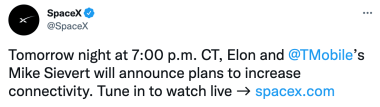
I’m interested to see what will be announced by T-Mobile and SpaceX later this evening. SpaceX posted this on their Twitter account yesterday:

My guess is Starlink backhaul for remote T-mobile towers to expand their footprint. It’ll be much easier for them to connect to Starlink than run fiber to hard to reach places.

Also yesterday Apple dropped the invite for their latest iPhone event. No, I was not invited but I did see what the invite looked like from what others have posted:

Apple’s Tweet announcing the event also alludes to an outer space theme:

My guess on Apple’s announcement is that new iPhones will work with the Globalstar constellation of low earth orbiting satellites. A few months ago Globalstar announced a major deal with a “global customer” for some form of connectivity from their satellites.

But don’t you need a huge dish for this? Nope! As I demo’ed the other day a handheld radio can get short messages (and sometimes full voice communications) back and forth to the International Space Station. Larger antennas make it easier of course but if there’s a satellite always overhead the challenge of getting a message delivered is reduced significantly.

I did a whole video about this a few months ago. You can check it out here!

The Week Ahead

This will most definitely be a busy week! I have a few videos “in the can” coming up including a review of a WD external SSD for gamers posting tonight, a VisionTek portable dock that I think works well for desktop use and a look at how a smartphones can send text messages through the ISS without a cellular network or Internet.

I also hope to shoot my next Plex video this week along with one or two other video reviews. I am overloaded with laptops again so I will try to get one or two of those done. I’m also eager to dig into the Unihertz phone that has a built in HAM radio.

On Saturday I’ll be at RetroWorldExpo in Hartford, Connecticut. From there I’ll be heading to the airport and flying down to Florida for the launch of Artemis I! After that we’ll get back to a more regular cadence here.

Stay tuned!

You can communicate with the ISS using just a handheld radio with its built in “rubber duck” antenna!

Now that the ISS’s digipeater is active there are several opportunities per day to try out different ways of confirming a radio contact with it.

Yesterday I wanted to see if it’s possible to get a data packet heard by the station 250 miles up with just the “rubber duck” antenna that came equipped with my super low-end 8 watt Baofang BF-F8HP radio (affiliate link).

Normally for satellite communications I use an Arrow Antenna designed specifically for satellite work. But is it possible to use something smaller and more portable? The answer is yes but it’s going to be much more challenging.

I attempted this contact when the station was almost directly over my location for the best results. I attached the radio to my computer with the BTECH-APRS-V01 (affiliate link) cable that converts the radio’s mic and headphone jacks into a three prong TRRS connector for smartphones and laptops with a single headphone/microphone jack on board.

After sending a ton of packets into the air while tracking the station with my smartphone it looks like one of them actually made it according to ARISS.net that listens for packets beamed back down from the station.

I was traveling when I did this so I didn’t have my Windows computer with me. I used an iOS app called PulseModem running on my Mac in its iOS compatibility mode. It was having trouble triggering the radio’s VOX so I probably sent less packets than I thought I did. I ended up holding down the PTT button on the radio and pushing transmit on the computer’s screen.

I’m looking forward to seeing how this works with a more reliable set up on future passes!

What’s On Tap This Week and Next

The next two weeks will be a little disruptive from my usual production cadence. I have a quick day trip out to New York City tomorrow for a product preview that you’ll see a little later in September and then taking a few days off for some family time. The following week I’ll be headed down to Kennedy Space Center to witness the launch of Artemis I!

You can hear about all of the stuff I have in the works in last night’s wrapup video.

The good news is that I’m working to make sure I have plenty of content to bridge the gaps in production. So I have a bunch of things already “in the can” and at least one more video today I’m hoping to get done. A few projects I started did not go the way I had expected so they require a little more work.

Tomorrow I’ll have a review of the new Lenovo Slim 7 Pro X (affiliate link) probably the nicest laptop I’ve looked at from Lenovo over the last year. It’s relatively small and light but has both a Ryzen 6900HS AND a Nvidia RTX 3050 inside. I tested things using both the built in graphics and the discrete 3050 to see how this new AMD chip performs.

I will likely pop up with a livestream later this morning / early afternoon tinkering with an Atari 2600 and a flash cartridge for an upcoming video.

The ISS Digipeater is Active!

The astronauts turned on a data packet repeater on the space station last week. When the station is overhead licensed amateur radio operators can send short messages to the station and it re-transmits those messages back to the ground. I had a successful transmission on my first shot!

Somebody from Virginia heard me through the station and sent a message back:

To hit the repeater I used a handheld radio, an Arrow Satellite antenna, and a Signalink USB soundbox that I talked about in this video. I used a piece of software called PinPoint to manage the data packet traffic which connects up with another piece of software called Direwolf that listens for the packets and passes them to Pinpoint.

Here’s a fun video from RetroRecipes where they made contact using a Commodore 64! This worked because the packet data protocol used is the same one that was used in the 1980s to transmit data over the radio. Sometimes when something works it doesn’t need to change all that much.

This repeater isn’t always active. But the voice repeater on the station is usually going all the time. Sometimes you can even catch an astronaut operating the station during their break periods!

You can learn more about amateur radio on the ISS by visiting the ARISS website.

The Week Ahead

We’ve got another diverse range of content ahead this week.

One of the most successful series of smartphones I do on the channel are for Unihertz phones. They have carved out a niche for themselves making tiny phones and Android phones with Blackberry style keyboards. All of their phones are exceptionally rugged too which leads us to their latest creation called the “Tick Tock.”

The Tick Tock is a more traditional Android phone but it has a nifty second screen that can do a few functions now with more to come. You can get a sneak peak at it from my livestream I did on Amazon the other day (tune to about the 90 minute mark).

Also this week we’re going to look at the new Lenovo Slim 7 Pro X (affiliate link) which is powered by the new 6000 series Ryzen processors. It’s always fun to see how a new processor performs vs. the previous generation.

And finally we’ll have an interview I did with Tyler the Antenna Man! We’ll learn his origin story and how he became YouTube’s TV antenna expert and explore why there is no single “best” antenna on the market – but there are certainly a lot of bad ones.

I’m sure we’ll have a few other things in between too. Stay tuned!

Jason Scott Unearths Another Internet Time Capsule

Jason Scott, aka textfiles, is a master digital historian who works for the Internet Archive. Jason is the man behind the BBS Documentary, Get Lamp, and countless other pieces of digital history that are safely stored on his website but also on the Internet Archive.

His latest find is a 1996 documentary entitled “Life on the Internet” and is hosted by NPR’s Scott Simon. Scott describes it as follows in a twitter thread as:

It is well-made, narrated by NPR voice of Weekend Edition Scott Simon, and, after those of us perform the requisite oos and aahs of memory and nostalgia for the 1990s, is most striking for its off-the-rails naivety about the effects the Internet would have on society and life.

I was handed the VHS tapes over the weekend and I got all 13 done in a day and a half, and I wanted you all to see it as soon as possible. Scott Simon is, and I can’t emphasize this enough, a beyond sneering skeptic throughout the entire series. Nothing misses his contempt.

But once you wade past his sarcasm and disdain, you run into faces like James Gosling, who created Java, and the founders of Yahoo, before they got a chance to ruin everything.

Each episode is 30 minutes, the names are strangely spoken and not given title cards, but if you were there, you’ll get a rush of memories; and if you weren’t there, see how much we got it wrong.

The Week Ahead

Another week is upon us! I already have two videos shot and recorded that just need a little editing and polish. The first one you’ll see is the Lenovo Thinkpad X13s, an ARM powered Windows laptop. Windows 11 appears to have solved many (but not all) of the compatibility issues we saw with prior Windows ARM laptops I’ve reviewed. The 3rd generation 8cx processor also appears to be an improvement. Look for that one likely tomorrow night.

Also ready to go is part 2 of my tour of the ARRL headquarters for amateur radio here in the United States. I was disappointed that there wasn’t more viewership for Part 1 but I expect this video to improve in performance over time as the algorithm puts it in front of people who have more interest in the topic.

Also on the docket for this week is a new NAS device from ioSafe that’s designed to be fireproof and waterproof! We’ve reviewed these in the past – they are Synology NAS devices repackaged into these fireproof boxes.

Additionally got in a bunch of quick hit items that we’ll unbox on an Amazon Live Stream later this week too.

I think I might also do an update on the Analogue Pocket as it now looks like their new firmware allows for additional cores to be installed in the device.

Playing with the ThinkPad X13s Today

Back in March I was at a Lenovo preview event for their summer releases and they had a very intriguing ThinkPad on display with a new Snapdragon ARM processor. They sent me a loaner unit this week so I’m going to begin playing around with it today on a live stream.

Set your notifications! I’ll probably pop on YouTube and Amazon.